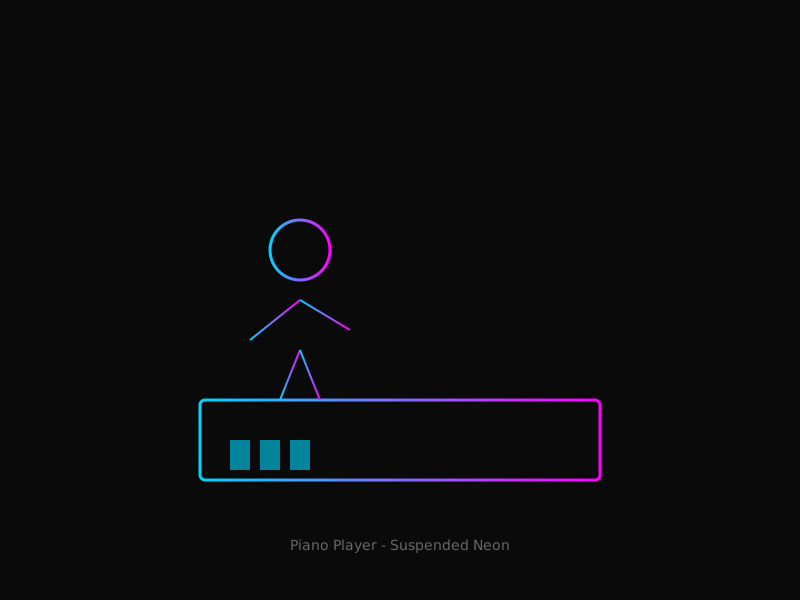
A suspended neon sculpture capturing the grace and elegance of a pianist lost in musical contemplation, frozen in a moment of artistic transcendence.
Concept & Vision
Piano Player was inspired by a late-night visit to Carnegie Hall, watching a pianist rehearse alone. The solitary figure, silhouetted against the stage light, created a visual that stayed with me for years before finding its ultimate form in neon.
The sculpture reduces the pianist to its essential gesture—the curved spine, the raised arms, the倾head. These gestural elements are translated into graceful tube bends, while the piano itself is suggested through geometric angles that echo its form without replicating it.

Technical Approach
The piece is constructed from hand-bent glass tubing filled with a unique phosphorescent gas mixture that produces a warm, amber glow distinct from traditional neon colors. The tubes are mounted on a minimal steel armature that disappears visually, creating the illusion of the figure floating in space.
The warm color palette was chosen deliberately to evoke the intimacy of a rehearsal space, contrasting with the typical cool blues of the artist's other work. This piece represents a more personal, contemplative direction in the body of work.
Specifications
Exhibition History
Piano Player was first exhibited at the Neon! solo exhibition in 2005, where it served as the emotional centerpiece of the show. Its placement in a small alcove off the main gallery forced intimate viewing, inviting visitors to approach as if witnessing a private moment.
The piece was acquired by a private collector in Tokyo following the exhibition, where it hangs in a traditional tea house context—a dialogue between Western and Eastern aesthetic sensibilities.
Viewer Experience
The piece demands quiet contemplation. Visitors often speak in whispers near the work, as if not wanting to disturb the pianist's reverie. The warm glow creates an intimate envelope of space that feels sacred and private.
Many viewers report hearing music in their minds when viewing the piece, suggesting the work successfully bridges the visual and auditory imagination. It's a rare piece that evokes sound through sight alone.