An exploration of infinite patterns through sequenced neon choreography, where programmable light creates ever-evolving visual compositions that reward sustained viewing with new discoveries.
Concept & Vision
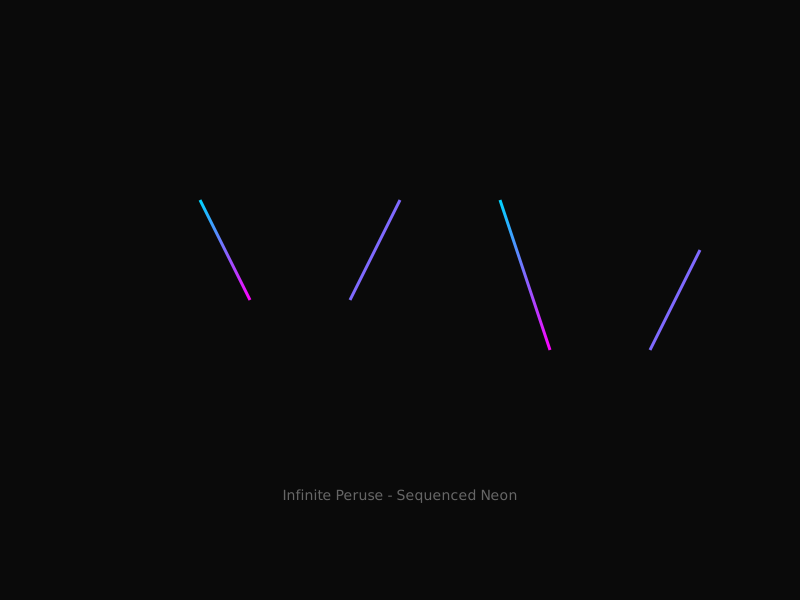
Infinite Peruse was born from a fascination with how simple rules can generate endless complexity. The installation uses a custom algorithm to sequence 312 individual neon tubes, creating patterns that never exactly repeat, yet maintain an underlying coherence that feels both ancient and alien.
The title references the act of contemplating a great text—the sense of endless discovery in returning to something rich with meaning. Viewers often report seeing different imagery in the same patterns depending on their mood and the time they've spent with the piece.
Technical Approach
The installation employs a microcontroller system that manages 312 individually addressable neon tubes using a variant of the Rule 110 cellular automaton. This creates organic-seeming patterns that emerge from simple local rules, giving the impression of a living system rather than a programmed sequence.
The color progression follows a carefully calibrated journey through the visible spectrum, with transitions so gradual they're often imperceptible moment-to-moment but create dramatic shifts over the full viewing period. No two showings are identical—the piece regenerates based on an initial seed.
Specifications
Exhibition History
Infinite Peruse debuted at First Night Binghamton 2005, where its location in the museum's long corridor allowed viewers to experience it as a journey, with the pattern visibly evolving as one walked the length of the piece.
The piece was selected for the 2006 Transmediale festival in Berlin, where it was installed in the festival's main venue, running continuously for the six-day duration of the event.
Viewer Experience
The piece rewards patience in a way few contemporary artworks do. Patterns that seem static resolve into motion; formations that seemed random reveal underlying geometries. The longer one watches, the more one sees—a meditation on perception itself.
Many visitors return multiple times during an exhibition, each time finding something new in the ever-shifting light. It's a piece that creates its own temporality, slowing down the viewer's experience of time.